They didn’t tell me about the Ombudsman during orientation.
They told me about the patients—how some would scream, some would whisper, some would sit so still you’d forget they were alive. They told me never to run if a patient chased me, never to argue with a delusion, and never to open Ward C after midnight.
But no one mentioned the Ombudsman.
I learned about him on my third night shift.
It was just past 2:00 a.m.—the hour when the hospital seemed to exhale and settle into something heavier. Fluorescent lights hummed. The halls stretched too long, like they didn’t quite belong to the same building anymore.
I was doing rounds, clipboard in hand, pretending I wasn’t counting my footsteps to stay calm.
That’s when I saw the door.
A narrow wooden one at the end of a corridor I knew had ended in a supply closet earlier. A brass plaque hung crooked on it:
OMBUDSMAN
The word felt wrong there. Too official. Too… alive.
I asked Marla about it when she came back from break.
She froze.
“You saw the door?” she asked.
“Yeah,” I said. “Who uses that office?”
Marla didn’t answer right away. She just stared at the hallway behind me like she expected something to be standing there.
Then she said quietly, “Don’t file anything.”
“File what?”
“Complaints,” she whispered. “Grievances. Requests. Anything.”
I laughed, a little too loud. “That’s literally part of the job.”
“Not here,” she said. “Not at night.”
I should’ve listened.
But near the end of the shift, I found one.
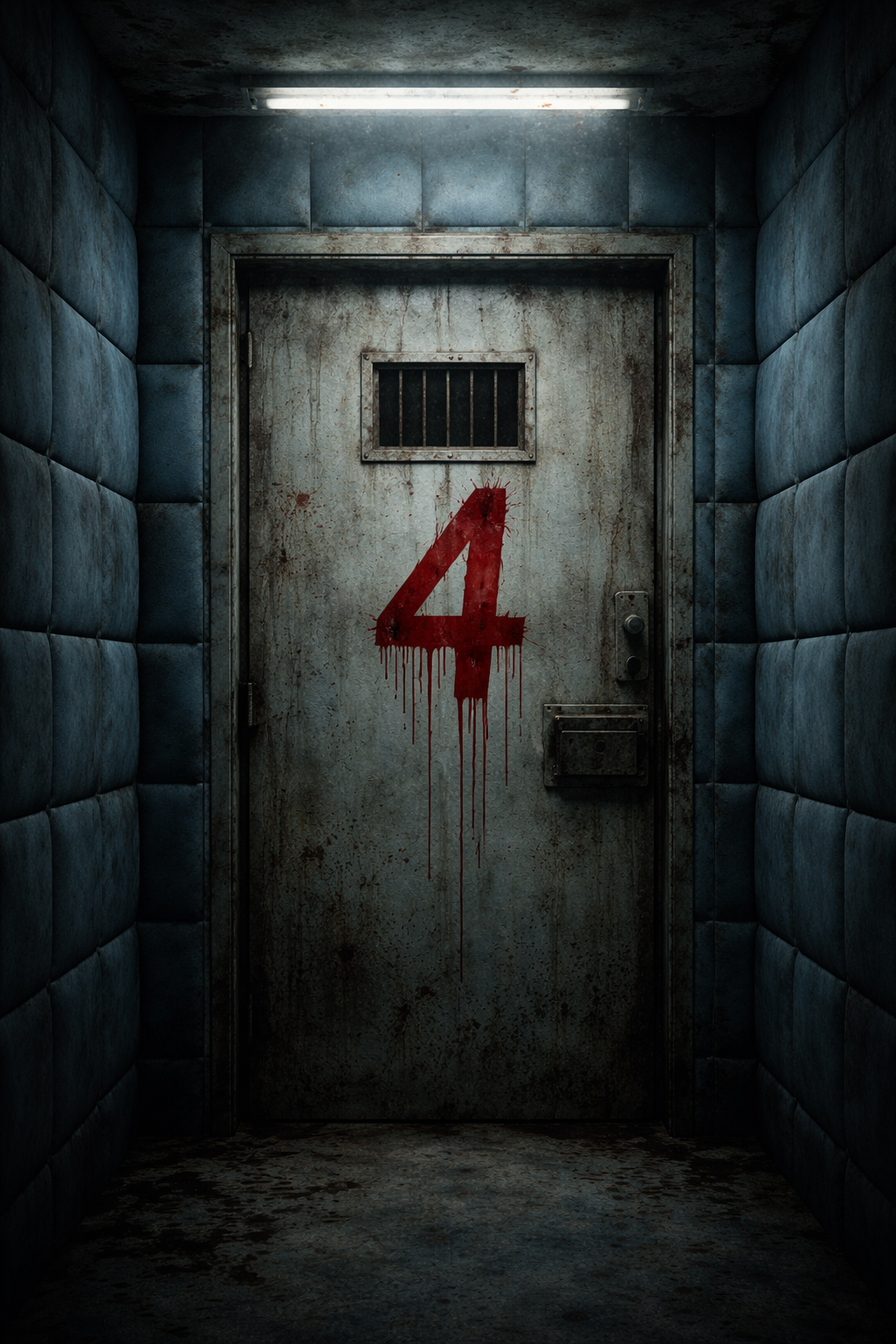
A patient with a fluctuating mood—Double Soft-Locked Room 4—had scratched something into the wall beside his bed. Over and over, deep enough to bleed:
HE DOESN’T CLOSE CASES
I don’t know why, but that stuck with me.
So when I passed that door again, I stopped.
It was slightly open now.
Inside, a single lamp glowed.
And there was a desk.
Neat. Organized. Papers stacked perfectly.
A chair behind it.
Occupied.
The man sitting there looked… wrong. Not in a grotesque way. In a misplaced way. Like he’d been cut from a photograph of a different decade and glued into this room.
Gray suit. Thin tie. Skin too pale to belong to someone living under fluorescent lights.
He looked up at me and smiled.
“I’ve been expecting a filing,” he said.
His voice was soft. Professional. Calm in a way that made my stomach tighten.
“I—I didn’t file anything,” I said.
He tilted his head slightly. “Everyone does. Eventually.”
He gestured to the chair across from him.
I didn’t sit.
“What is this?” I asked.
“This,” he said, tapping the stack of papers, “is accountability.”
I noticed then—each sheet had a name.
Patients.
Staff.
Hundreds of them.
Some crossed out.
Some circled.
Some… underlined again and again until the paper looked like it might tear.
“What happens to them?” I asked.
He smiled wider.
“They are heard.”
Something cold slid down my spine.
“I should go,” I said.
“Of course,” he replied. “But before you do…”
He pulled a blank form from the stack and slid it across the desk.
“Is there anything you’d like to report?”
The air felt thick. Heavy. Like the room was waiting.
I shook my head. “No.”
His eyes didn’t leave mine.
“Take your time,” he said gently. “We are very thorough here.”
I backed out of the room.
The door closed behind me without a sound.
—
The next night, Room 4 was empty.
No discharge paperwork.
No transfer.
Just… gone.
But the scratching on the wall was still there.
Only now it said:
CASE REVIEWED
—
I tried to forget about it.
I really did.
But over the next few nights, I started noticing things.
Patients who complained—loudly, desperately—would go quiet.
Staff who filed incident reports stopped showing up on the schedule.
And sometimes, late at night, I’d see that door again.
Always somewhere different.
Always slightly open.
—
On my last shift, I made a mistake.
A patient grabbed my arm. Hard.
“They’re not listening,” she whispered, eyes wide with panic. “No one listens here.”
I remembered the form.
The man.
The promise of being heard.
And against everything Marla had warned me…
I wrote it down.
A formal complaint.
Detailed. Careful.
I slipped it under the Ombudsman’s door.
The hallway went silent.
Not quiet—silent. Like sound itself had been removed.
The door creaked open.
“Thank you,” the man said from inside.
I didn’t see him move.
But the paper was gone.
—
The next morning, I wasn’t on the schedule anymore.
My ID badge didn’t work.
My name wasn’t in the system.
Marla wouldn’t meet my eyes when I found her.
“You shouldn’t have filed,” she whispered.
“What happens now?” I asked.
Her voice shook.
“He reviews the case.”
—
That was three nights ago.
I’m still here.
I don’t think I ever left.
The halls don’t end where they used to.
The lights hum louder now.
And tonight…
I found a door.
At the end of a corridor that shouldn’t exist.
The plaque is straight this time.
Polished.
Waiting.
OMBUDSMAN
And beneath it, freshly engraved:
CASE PENDING
The handle just turned.
And I can hear him inside.
Shuffling papers.
Getting ready to listen.
About The Author